The European Union is a community of states that decided to work together to ensure peace, stability and economic development for their citizens. Thanks to common rules and decisions, it is possible to travel, study and do business freely in many countries without unnecessary barriers.
The EU operates on the basis of agreed treaties, and its decisions are made through the cooperation of several key institutions. Each of them plays a specific role — from proposing new legislation, through its adoption, to implementation and oversight of compliance.
The European Parliament is the only institution of the European Union directly elected by citizens of the Member States. It represents their interests at the EU level and plays a key role in the legislative process, oversight of other institutions, and shaping EU policies. Members of the European Parliament are elected every five years in general elections.
Among the most important tasks of the European Parliament is co-creating EU law together with the Council of the European Union. Parliament analyses draft legislation, proposes amendments and approves the final wording of regulations. An important function is also democratic oversight of the activities of the European Commission — Parliament approves its composition, can question commissioners, and in extreme cases even dismiss the entire Commission.
Parliament also co-decides on the European Union budget and monitors how EU funds are spent.
Parliament's work takes place on several levels. Parliamentary committees play a key role, dealing with specific policy areas (e.g. the labour market, the environment or the economy). It is there that positions and amendments to legislative proposals are prepared.
Final decisions are made during plenary sessions in which all MEPs participate. Parliament sits mainly in Strasbourg, while the work of committees and political groups takes place primarily in Brussels.
Members of the European Parliament do not sit according to nationality, but form transnational political groups bringing together representatives with similar views. These groups play a key role in organising Parliament's work — they establish common positions, coordinate activities and influence the appointment of key positions and the allocation of legislative work.
To form a political group, certain requirements regarding the number of MEPs and represented Member States must be met.
The European Parliament is the central element of the European Union's democratic system. It ensures that the voice of citizens is taken into account in decision-making at the European level, and its role has been steadily growing with each successive treaty reform.
 More information
europarl.europa.eu
More information
europarl.europa.eu
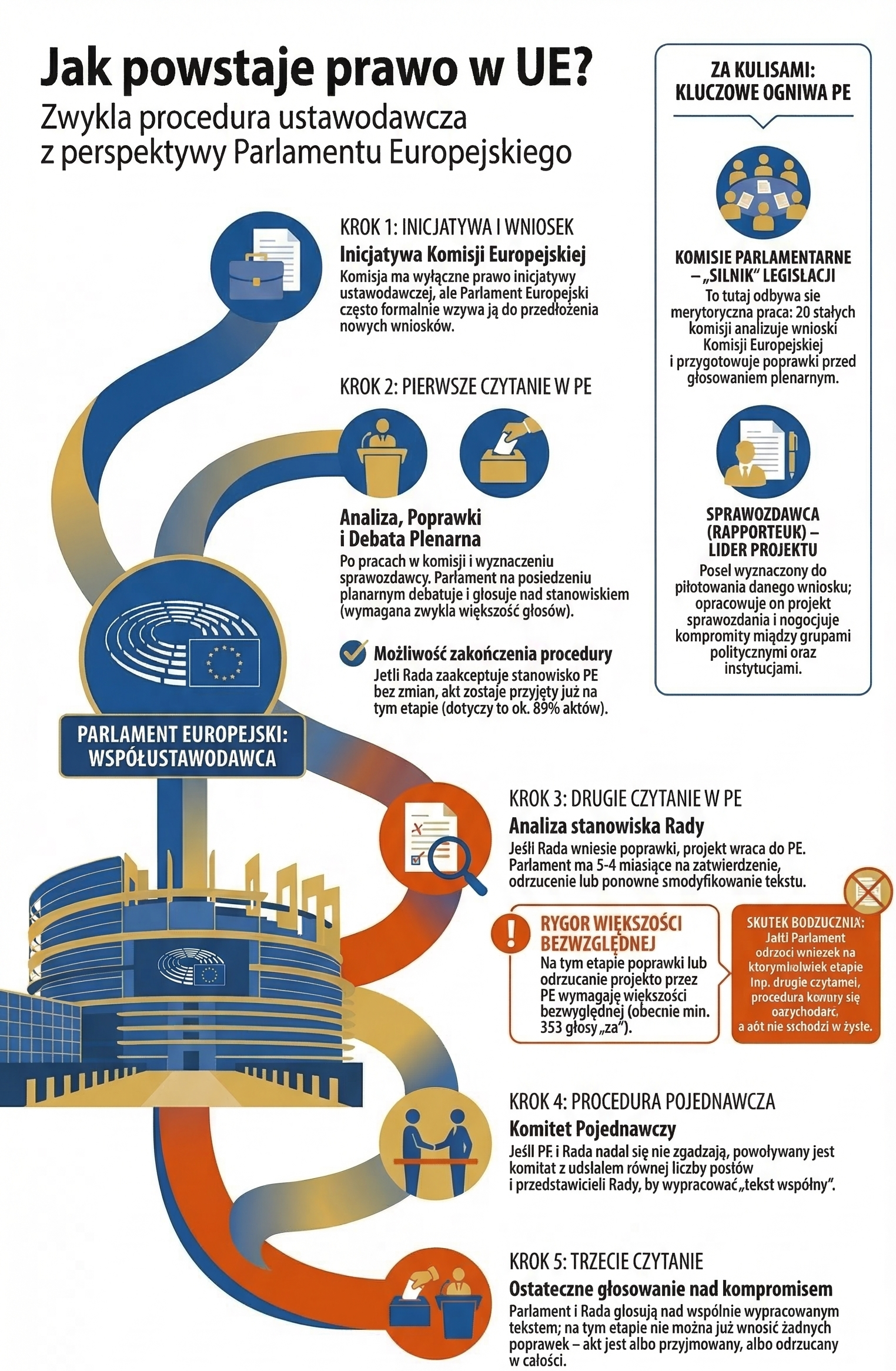
The legislative process in the European Union involves the joint adoption of law by the European Parliament and the Council of the EU, based on a proposal submitted by the European Commission.
Parliament plays a key role as co-legislator — it analyses the proposal, suggests amendments and negotiates its final form.
Work on legislation begins in parliamentary committees, which prepare positions and recommendations. Then the full Parliament votes on the proposal in plenary session. In the event of differences between Parliament and the Council, negotiations (known as trilogues) are conducted until an agreement is reached and the legal act is adopted.
The European Commission is the executive body of the European Union, which oversees the implementation of EU legislation and policies. The Commission is composed of 27 commissioners, one from each Member State, who are responsible for different policy areas such as trade, agriculture and digitalisation. The Commission is headed by its President, elected by the European Parliament.
 More information
commission.europa.eu
More information
commission.europa.eu
Within the institutional structure of the European Union, there are two separate institutions with similar names: the European Council and the Council of the European Union. Although both play an important role in the functioning of the EU, their competences and nature of operation are clearly different. The European Council performs a strategic function, setting the general direction of the Union's development, while the Council of the European Union participates directly in the legislative process and decision-making.
The European Council meets at least four times a year in Brussels and is composed of the leaders of the Member States (prime ministers, presidents), the President of the European Council and the President of the European Commission.
The main tasks of the European Council are resolving crises, setting the EU's long-term strategy, e.g. on economic, climate and foreign policy issues. Decisions of the European Council are taken by consensus.
The Council of the European Union, often called the Council of Ministers, is the main decision-making body of the EU representing the governments of the Member States. It is composed of ministers from each Member State, and the composition of the Council changes depending on the subject matter being discussed (e.g. health ministers, finance ministers). The Council of the EU has three main functions:
The Council usually adopts decisions by qualified majority voting, with larger countries having more votes, but each country having equal decision-making power on key issues.
 More information
consilium.europa.eu
More information
consilium.europa.eu